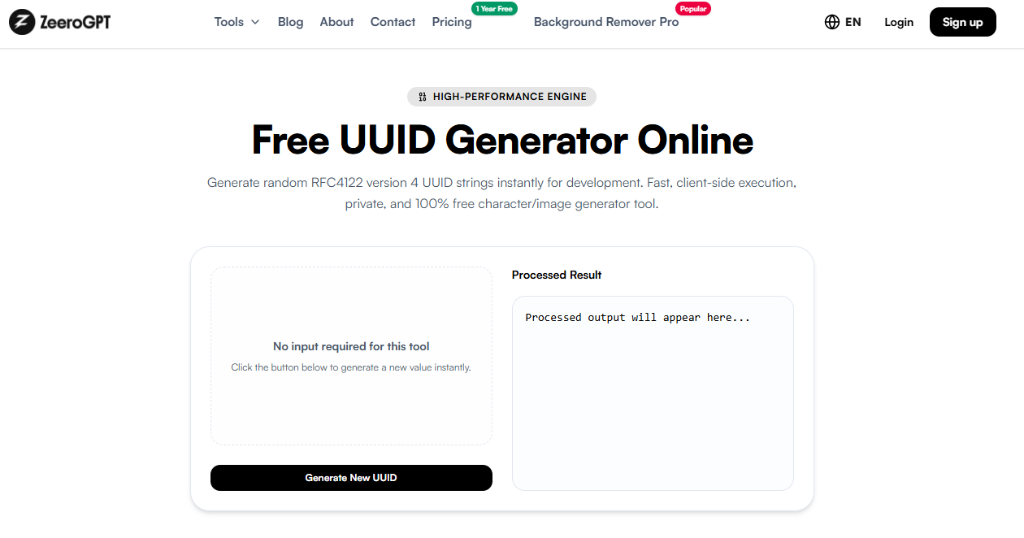
Generate random RFC4122 version 4 UUID strings instantly for development. Fast, client-side execution, private, and 100% free character/image generator tool.
No input required for this toolClick the button below to generate a new value instantly.
In modern software development, every application needs a reliable way to identify records, users, devices, transactions, or files without creating duplicates. This is where UUIDs (Universally Unique Identifiers) come in. A UUID is a 128-bit identifier designed to be unique across systems, databases, and applications, making it an essential part of modern software architecture.
The ZeeroGPT UUID Generator lets you create secure, random, and standards-compliant UUIDs instantly. Whether you're building APIs, designing databases, testing applications, or generating unique identifiers for projects, this tool provides a fast and convenient solution directly from your browser.
What Is a UUID?
A UUID (Universally Unique Identifier) is a 128-bit value used to uniquely identify an object or resource. It is typically displayed as a 36-character string containing hexadecimal digits separated by hyphens, for example: 550e8400-e29b-41d4-a716-446655440000
Because UUIDs are generated using standardized algorithms, the chance of two randomly generated UUIDs being identical is extremely small. This makes them ideal for distributed systems where uniqueness is critical.
Why Use a UUID Generator?
Prevent Duplicate IDs: Generate unique identifiers without relying on auto-incrementing numbers.
Support Distributed Systems: Multiple servers and applications can generate UUIDs independently without conflicts.
Improve Database Design: UUIDs work well as primary keys in databases where global uniqueness is required.
Secure Resource Identification: UUIDs are difficult to guess compared to sequential numeric IDs.
Simplify Application Development: Generate identifiers instantly without maintaining a central ID service.
Features of the ZeeroGPT UUID Generator
Generate UUIDs instantly with RFC 4122 compliance.
Browser-based tool — no data is ever sent to external servers.
No software installation or account required.
Free to use with no generation limits.
One-click copy functionality for quick workflow integration.
Suitable for development, testing, and production use.
How to Use the Tool
Step 1: Open the ZeeroGPT UUID Generator.
Step 2: Choose the desired UUID format or version if available.
Step 3: Click "Generate UUID".
Step 4: Copy the generated UUID using the one-click copy button.
Step 5: Use it in your application, database, API, or project.
Common Applications
Database Primary Keys: Assign globally unique IDs to records.
REST APIs: Generate unique identifiers for resources and requests.
Mobile Applications: Identify users, devices, or sessions.
Cloud Services: Track resources across distributed environments.
File Management: Assign unique names to uploaded files to prevent overwrites.
Software Testing: Generate random IDs for unit testing and integration testing.
Who Can Benefit?
The UUID Generator is useful for Software Developers, Backend Engineers, Frontend Developers, API Developers, Database Administrators, DevOps Engineers, Cloud Architects, QA Testers, and Students Learning Programming.
UUID vs Auto-Increment IDs
UUID
Auto-Increment ID
Globally unique
Unique only within one database
Difficult to predict
Sequential and predictable
Suitable for distributed systems
Best for single databases
No central generator required
Requires database sequence
Fixed 128-bit format
Usually numeric values
UUIDs are the preferred choice when applications need globally unique identifiers across multiple systems.
Common UUID Versions
Version 1: Generated using timestamps and device information.
Version 3: Generated using a namespace and an MD5 hash.
Version 4: Generated using random numbers — the most commonly used version.
Version 5: Generated using a namespace and a SHA-1 hash.
Version 7: A newer version designed to be time-ordered for improved database performance and indexing.
Benefits of Using a UUID Generator
Eliminates duplicate identifiers across systems and databases.
Supports distributed applications at any scale.
Improves security compared to sequential numeric IDs.
Works across databases, servers, and programming languages.
Saves development time and reduces architectural complexity.
Easy to integrate into any API or application layer.
Reliable for large-scale enterprise systems.
Best Practices
Use Version 4 UUIDs for most applications requiring random identifiers.
Choose Version 7 when chronological ordering improves database index performance.
Store UUIDs using native UUID data types when supported by your database.
Avoid manually editing generated UUIDs to prevent format corruption.
Generate a new UUID for every unique resource or database record.
Frequently Asked Questions (FAQ)
Final Thoughts
Unique identifiers are essential for building reliable and scalable applications. The ZeeroGPT UUID Generator makes creating these identifiers simple, fast, and dependable. Whether you're assigning IDs to database records, tracking resources across distributed systems, or generating random identifiers for testing, the tool helps you create globally unique UUIDs with just a click — making it a practical utility for developers, students, and IT professionals alike.

 ZeeroGPT